


0


What else can I help you with?
In triangle DEF angle E is 3 times angle D and angle F is 9 less than angle E what is the measure of each angle?
D=27 E=81 F=72
In a parallelogram the measure of angle b the measure of angle a by 30 degrees what is the measure of angle d?
105 degrees
What else would need to be congruent to show that abc def by asa?
Angle "A" is congruent to Angle "D"
If angle a and b are complementary and angles c and d are supplementary then d is what angle?
It can have any value in the range (0, 180) so it can be acute, right or obtuse.
In this parallelogram the measure of angle B exceeds the measure of angle A by 30 degrees What is the measure of angle D?
In a parallelogram adjacent angles are supplementary, so angles are 75 degrees (A & C) and 105 degrees (B & D).
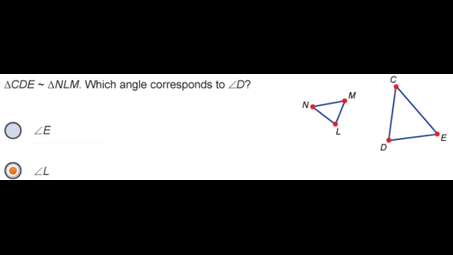
Is angle abc similar to DEF?
To determine if angle ABC is similar to angle DEF, we need to check if their corresponding angles are equal. If angle A corresponds to angle D, angle B corresponds to angle E, and angle C corresponds to angle F, and they all have the same measures, then angle ABC is similar to angle DEF. Otherwise, they are not similar. Without specific angle measures, we cannot conclude similarity.
Where is the orthocenter of obtuse triangle CDE located?
In an obtuse triangle, the orthocenter is located outside the triangle. For triangle CDE, if angle CDE is obtuse (greater than 90 degrees), the orthocenter will be situated outside of the triangle, specifically in the direction of the obtuse angle. This is a distinctive property of obtuse triangles, contrasting with acute and right triangles where the orthocenter lies inside or at a vertex, respectively.
what- FISH . which angle corresponds to?
A
what- Fish .... which angle corresponds to S?
A
If CDE equal 55 degrees then what is BDE?
I assume that points BC is a straight line and that D is the point where the line DE intersects BC. If this is so, and CDE is 55 degress, then BDE is 125 degrees.
Cde measures less than 180 but more than 90 is abc a right acute obtuse or straight angle?
you are a dummy!
What letter corresponds to a leg of the right angle?
L perhaps
What is the angle that corresponds to 20 percent?
20% = 72 degrees
If angle A plus angle D equals 90 the angle A and angle D are what kind of angles?
acute
How do you get 2 the cuteness page on cde?
just search cde cuteness on google
What is the angle corresponds to 65 percent?
Obtuse if that's not the type of answer your looking for then GOOGLE it
Who is the boy in love with a fish on cde?
One thing...CDE iS aWESOME! xD and it is.. sea love
