


0


What else can I help you with?
What type of triangle is always similar to all other triangles of the same type?
90 degree triangles are always similar.
When one diagonal is drawn in a rectangle what type of triangles are formed?
Two right angle triangles, normally scalene triangles. However, if the rectangle is for example a square, then it would be two isosceles triangles.
What is the difference between goal conflict and goal congruence?
Goal conflict is when we have alternative goals including both Minimization and Maximization of problem .And Goal congruence is when we have alternative goals of same type , either maximizatioin or minimization. Example: Minimizing distance and maximizating closeness ratio in facility layout problem are two conflict goals. Minimizing flow and minimizing risky transpot are congruent goals.
A parallelogram can be split into what type of triangle?
Generally a parallelogram will be split into two scalene triangles by a diagonal; depending upon which diagonal, they will be acute or obtuse. However, it is possible for the diagonal to be the same length as one of the sides, in which case it will be split into two isosceles triangles. For the special case of the "regular" parallelogram (whereby every side is equal in length, and it is otherwise known as a Rhombus) it will generally be split into two isosceles triangles, but the diagonal could be the same length as the sides and it will be split into two equilateral triangles.
Name the type of special quadrilateral that will appear when you join two congruent equilateral triangles?
There are two types of quadrilaterals that are formed when two congruent equilateral triangles are joined. These shapes are rhombus and parallelogram.
The properties of a triangle?
there are many properties of triangles more than i could type there are congruence properties similarity properties and trigonometric properties just to name a few if you have a specific one you would like more information about ask
How do the HL Theorem and the SAS Postulate compare?
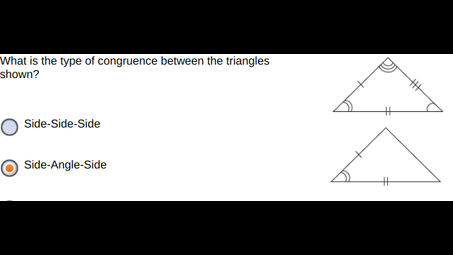
The HL Theorem (Hypotenuse-Leg Theorem) and the SAS Postulate (Side-Angle-Side Postulate) are both methods used to establish the congruence of triangles, but they apply in different contexts. The HL Theorem specifically applies to right triangles, stating that if the hypotenuse and one leg of a right triangle are equal to the hypotenuse and one leg of another right triangle, then the two triangles are congruent. In contrast, the SAS Postulate applies to any type of triangle, stating that if two sides and the included angle of one triangle are equal to two sides and the included angle of another triangle, the triangles are congruent. Thus, while both are used for proving triangle congruence, they cater to different triangle types and conditions.
What are Polenta Triangles?
Polenta is a type of flour so polenta triangles is polenta flour shaped into triangles.
What type of triangle is always similar to all other triangles of the same type?
90 degree triangles are always similar.
Can you explain the properties and characteristics of triangles?
Triangles are geometric shapes with three sides and three angles. The properties of triangles include the sum of angles always being 180 degrees, the side lengths determining the type of triangle (such as equilateral, isosceles, or scalene), and the Pythagorean theorem for right triangles. Characteristics of triangles include their area, perimeter, and the relationships between their sides and angles.
What type of triangles has three side of equal length?
Equilateral triangle
What are the 3 types of triangles?
3 type of triangles are isoceles acute and obtuse triangles.
What are equivalent triangles?
They are triangles with 3 equal sides and 3 equal interior angles or triangles that are congruent in shape
What type of triangles are there and what do they look like?
They are Similar triangles if they have the same angles. it they are exactily the same they are Equaltrial.
Is a triangle always half a square?
No, a triangle is not always half a square. While a right triangle can be considered half of a rectangle (which is a type of square), this is not true for all triangles. Triangles can have various shapes and sizes, independent of squares. Therefore, the relationship between triangles and squares is not universally applicable.
What type of relationship is shown by lichen?
It is an intermediate between fungi and lichen. It is also a biological indicator
What type of faces does a tetrahedron have?
equilateral triangles
